Early Detection of Colorectal Cancer from Gut Microbiome Data using FT-Transformer
A clinical-grade deep learning diagnostic system leveraging Feature Tokenization and Multi-Head Self-Attention to identify early-stage Colorectal Cancer dysbiosis markers from metagenomic relative abundance profiles.
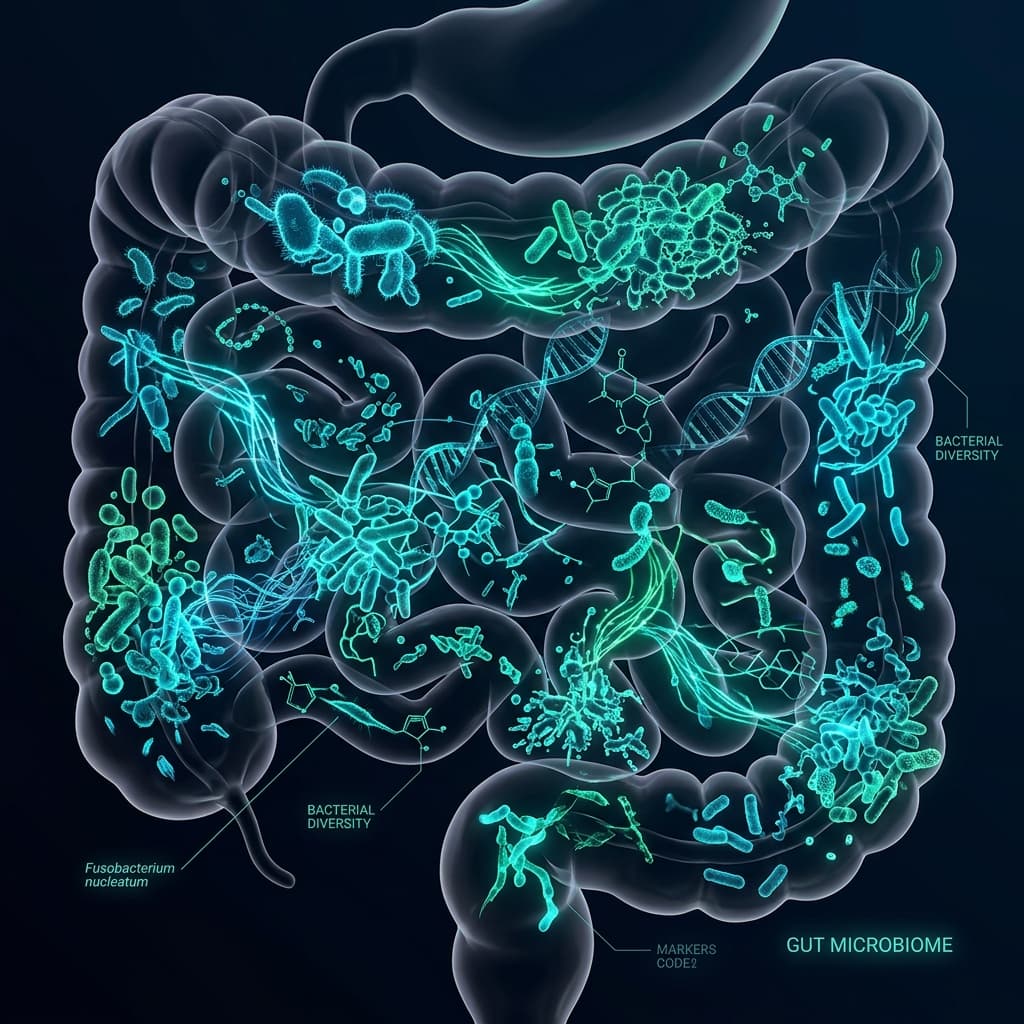
Gut Microbiome Architecture & Key Taxa Indicators
High-resolution metagenomic micro-flora mapping and dysbiosis driver analysis
Select Taxon Biomarker to Inspect
Fusobacterium nucleatum
Adheres to intestinal epithelial cells, promoting inflammation and tumor proliferation in early CRC stages.
End-to-End Deep Learning Research Pipeline
Strict scientific methodology from raw reads to clinical decision support
1. Data Ingestion & CLR
Centered Log-Ratio transformation resolves compositional constraint bias in metagenomic abundance.
2. FT-Tokenizer
Numerical features projected to dense vector embeddings with learnable [CLS] token insertion.
3. Self-Attention Encoder
Multi-Head Self-Attention layers model non-linear inter-microbial dysbiosis dependencies.
4. SHAP Biomarkers
Attribution engine isolates Fusobacterium nucleatum & key dysbiotic drivers for clinical validation.